Bitumen Types, Grades & Specifications: The Complete 2026 Reference Guide
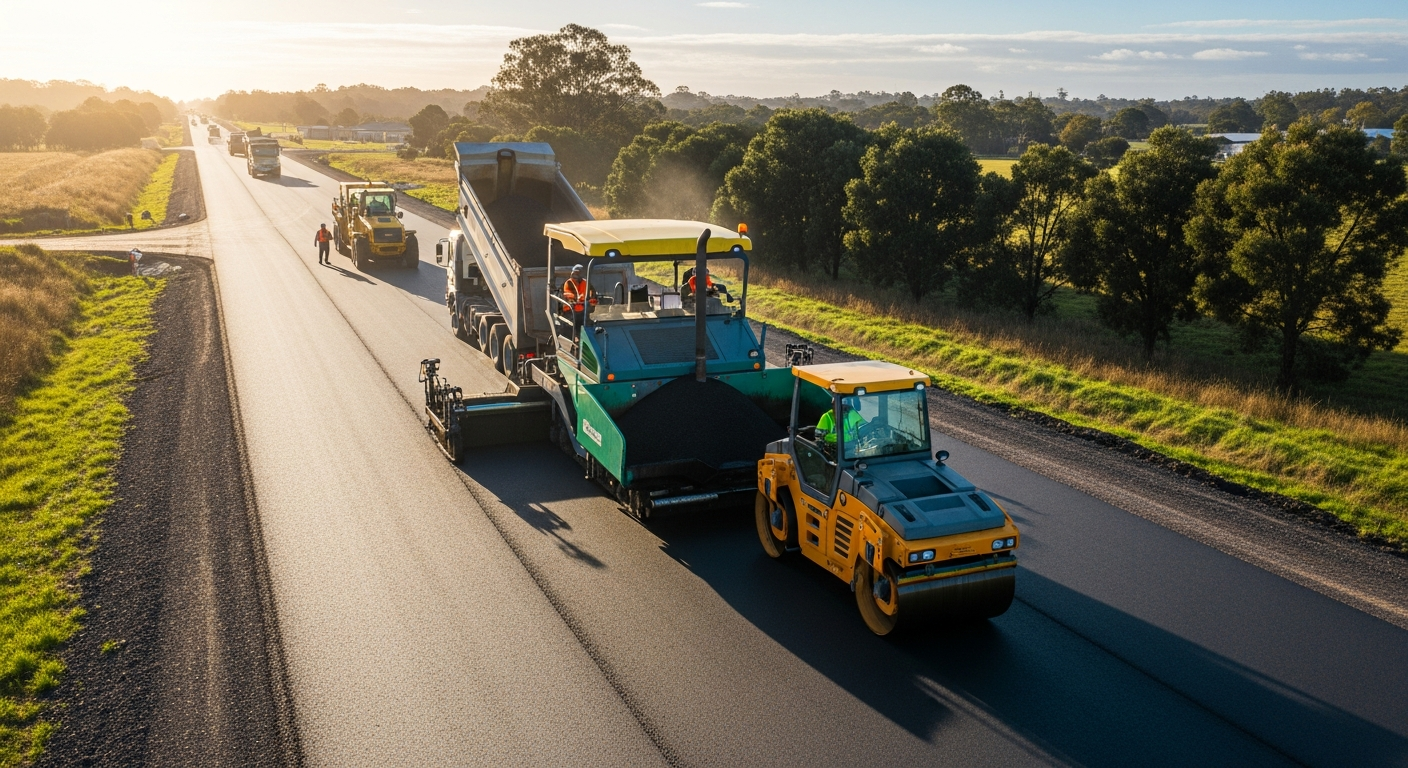
Bitumen — called asphalt cement in North America — is the critical binding agent in pavement construction. The grade and type you specify determines how the finished pavement performs across its design life, from its resistance to summer rutting to its resilience against winter cracking. Choosing the wrong grade can shorten pavement life by 40–60%. This guide covers every major bitumen classification system and how to match the right grade to your project requirements.
The Five Major Bitumen Types
1. Penetration Grade Bitumen — The Traditional Standard
Penetration grade bitumen is classified by the distance (in tenths of a millimetre) that a standard 100-gram needle penetrates the bitumen over 5 seconds at 25°C. A lower penetration number indicates harder bitumen; a higher number indicates softer bitumen.
| Grade | Penetration (0.1mm) | Typical Application | Climate Suitability |
|---|---|---|---|
| 30/40 | 30–40 | Airport runways, industrial | Very hot (Middle East, tropics) |
| 40/50 | 40–50 | Heavy traffic roads, highways | Hot climates (Southern US, SE Asia) |
| 60/70 | 60–70 | National highways, urban roads | Moderate (most of US, Europe) |
| 80/100 | 80–100 | Rural roads, light traffic | Cold/temperate climates |
| 120/150 | 120–150 | Slurry seals, roofing applications | Very cold climates |
The 60/70 grade is the most widely used globally and is the baseline for most road construction projects in the continental United States, Europe, and Australia. When specifications simply say "standard bitumen" without further qualification, 60/70 pen grade is usually implied.
2. Performance Grade (PG) Bitumen — The Superpave Standard
Performance Grade bitumen, developed as part of the SHRP (Strategic Highway Research Program) and used in Superpave mix design, classifies bitumen by its actual performance temperatures rather than a simple penetration measurement. This is a more scientifically rigorous system because it directly measures how the binder performs at the temperatures the pavement will actually experience.
A PG grade designation uses two temperatures: PG [high temp]-[low temp]. For example, PG 64-22 means the binder meets high-temperature performance criteria up to 64°C and low-temperature performance criteria down to -22°C.
| PG Grade | High Temp Performance | Low Temp Performance | Typical US Region |
|---|---|---|---|
| PG 52-28 | Up to 52°C | Down to -28°C | Northern Canada, Alaska |
| PG 58-28 | Up to 58°C | Down to -28°C | Northern Minnesota, Wisconsin |
| PG 64-22 | Up to 64°C | Down to -22°C | Most of the continental US (most common grade) |
| PG 70-22 | Up to 70°C | Down to -22°C | Southeast US, mid-Atlantic summers |
| PG 76-22 | Up to 76°C | Down to -22°C | Southwest US (Phoenix, Las Vegas) |
| PG 82-22 | Up to 82°C | Down to -22°C | Extreme desert Southwest |
3. Polymer-Modified Bitumen (PMB) — Premium Performance
Polymer-Modified Bitumen adds polymer additives to standard bitumen to enhance specific performance characteristics. PMB is specified for high-traffic highways, airports, bridge decks, and any application where standard bitumen cannot meet the required performance level.
Common polymer modifiers and what they do:
- SBS (Styrene-Butadiene-Styrene): The most common elastomeric modifier. Improves both high-temperature rutting resistance and low-temperature cracking resistance. Extends the usable temperature range of the binder. Cost: 20–40% premium over standard bitumen.
- SBR (Styrene-Butadiene Rubber): Latex-based modifier added as emulsion. Improves elasticity and fatigue resistance. Common in chip seal and slurry applications. Lower cost than SBS.
- EVA (Ethylene-Vinyl Acetate): Plastomeric modifier that increases high-temperature stiffness. Primarily used in hot climates where rutting is the dominant distress mode.
- Crumb Rubber (GTR): Recycled tire rubber added to bitumen. Provides elasticity at low temperatures and stiffness at high temperatures. Increasingly popular due to sustainability and performance benefits. Some states (California, Florida) mandate minimum crumb rubber content in highway projects.
4. Bitumen Emulsion — Water-Based, Ambient Application
Bitumen emulsions disperse bitumen droplets in water with an emulsifying agent, producing a stable liquid that can be applied at ambient temperatures without heating. When the water evaporates (or "breaks"), the bitumen residue bonds to the aggregate.
Emulsions are classified by charge (cationic/anionic), setting speed (rapid/medium/slow), and residue content. Common grades include:
- CRS-1, CRS-2 (Cationic Rapid Setting): Used for chip seals and surface treatments
- CMS-2 (Cationic Medium Setting): Used for cold mix patching and open-graded aggregate bases
- CSS-1, CSS-1h (Cationic Slow Setting): Used for slurry seals, microsurfacing, and fog seals
5. Cutback Bitumen — Solvent-Diluted (Increasingly Restricted)
Cutback bitumen blends standard bitumen with petroleum solvents (naphtha, kerosene, diesel) to reduce viscosity at ambient temperatures. Once applied, the solvent evaporates, leaving the bitumen residue. Cutbacks are classified by curing speed: rapid-curing (RC), medium-curing (MC), and slow-curing (SC).
Important regulatory note: Cutback bitumen is increasingly restricted or banned in many US states due to VOC emissions from solvent evaporation. California, Oregon, and several northeastern states have substantially limited cutback use. Always verify local regulations before specifying cutback bitumen.
How to Select the Right Bitumen Grade for Your Project
Grade selection depends on four primary factors:
- Climate temperature range: Use the SHRP climate zone map to identify the appropriate PG grade for your location. In penetration grade terms, hotter climates need harder (lower penetration number) bitumen to resist summer softening.
- Traffic loading: Heavy axle loads from trucks and buses accelerate rutting. High-traffic routes warrant PMB or a harder PG grade bump. A residential driveway can use a softer grade than a state highway.
- Pavement layer: Surface course (wearing course) typically uses a harder grade than binder/base course layers because it is exposed to direct solar radiation and tyre friction.
- Special performance requirements: Bridge decks, airfield pavements, and parking structures have unique performance criteria and typically require specialty grades or modified binders.
Bitumen Content in Asphalt Mix Design
Bitumen content in a standard hot mix asphalt (HMA) mix is typically 4.5–6.5% by weight of the total mix. For a typical dense-graded HMA at 145 lb/ft³:
- A 5% binder content means 5 kg of bitumen per 95 kg of aggregate per 100 kg total mix
- For 100 tonnes of compacted HMA, you need approximately 5 tonnes of bitumen
- For a 500 sq ft × 3-inch driveway (~7.5 compacted tonnes), you need roughly 375 kg of bitumen
Our bitumen calculator handles this automatically — enter your project dimensions and mix design bitumen content to get exact bitumen requirements.
Frequently Asked Questions
Related Tools & Guides
- Free Bitumen Calculator — calculate bitumen quantity for any road or pavement project
- Asphalt Calculator — calculate HMA tonnage and volume
- Asphalt Cost Guide 2026 — current pricing by region
- Asphalt vs. Concrete Driveway — material comparison guide